Your Second Brain Is Organizational Masturbation.
I know exactly when a system has stopped serving me, because I start improving it instead of using it, and the worst part is that I usually know this while I am doing it. I can feel the fraud in real time: the small clean pleasure of renaming a tag, moving a note, fixing a template, changing a folder structure, convincing myself that this is not procrastination because the object being procrastinated on is, technically, called a knowledge system. The truth is uglier and more useful. I was not building a second brain. I was avoiding the first one.
A second brain sounds noble because it borrows the language of memory, compounding and intellectual seriousness, but most of the time it is just a socially acceptable way to keep touching the same pile without asking whether the pile has ever changed how you think. Before AI, this meant spending a Sunday afternoon in Obsidian changing #productivity to #prod, then back to #productivity, then into some nested taxonomy that felt profound for about eleven minutes. After AI, it means asking Claude Code to help me do the same thing faster, which is not progress, but the industrialization of the same private disease.
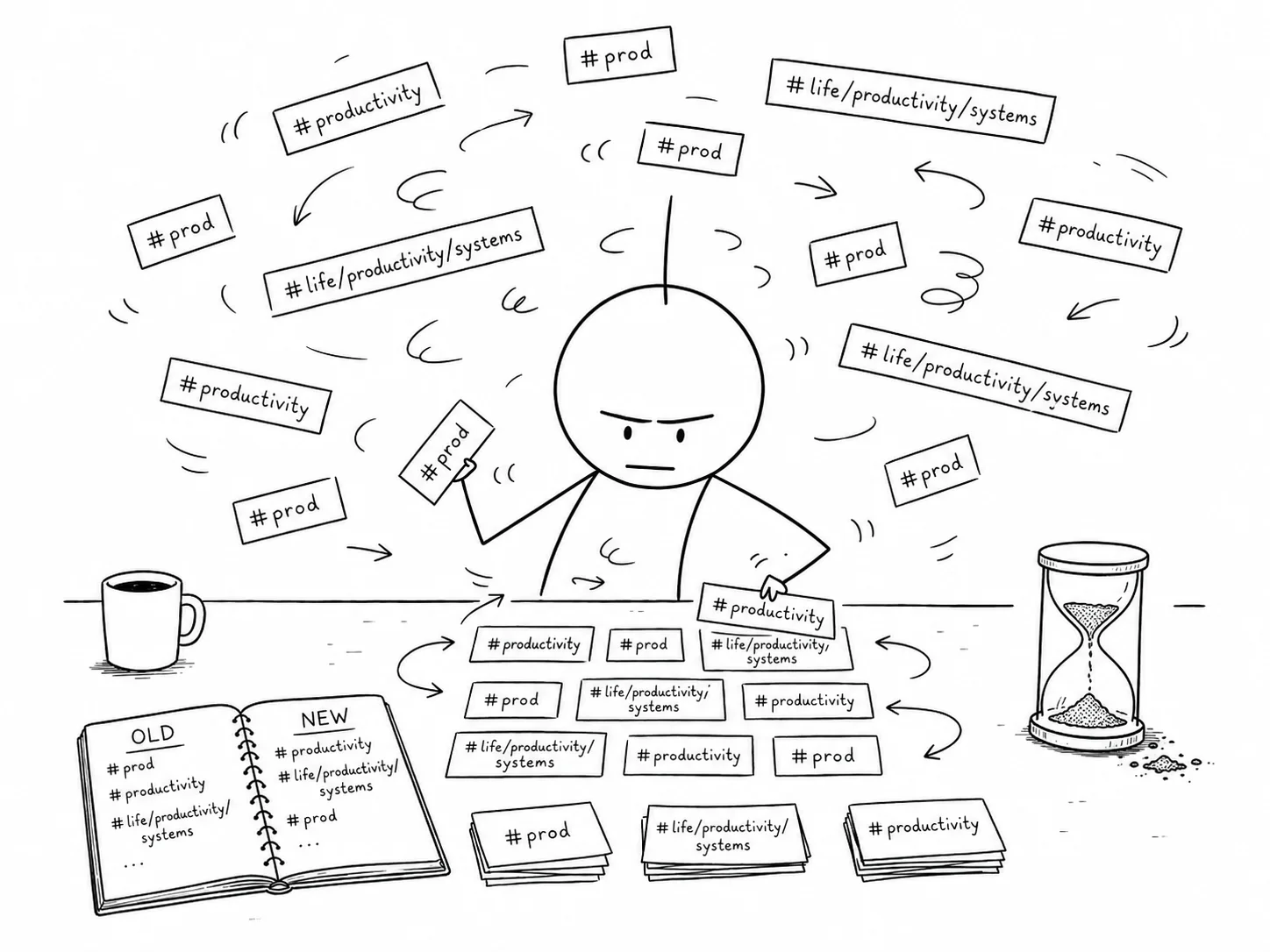
The disease is the moment a system becomes more emotionally rewarding than the work it was supposed to support, because the system always gives you a clean little proof that something happened, while the work gives you a sentence that sounds wrong, a flashcard you fail again, a decision you have to make without hiding behind preparation, and the unpleasant suspicion that maybe you did not need a better vault, only a smaller excuse.
The bait
This is the thing nobody in the second-brain industry will tell you, because their entire revenue model depends on it: the system is the work. The system is also why no work gets done. Building your “second brain” feels like the most important thing you can possibly be doing, because every minute you spend on it produces a tiny visible improvement to a structure that is yours, and every minute you spend writing something real produces a tiny visible humiliation: a sentence that does not yet sound right. One feels like progress. The other feels like having teeth pulled. Guess which one you will pick at 9pm on a Tuesday.
They sell you a methodology called Building a Second Brain, and his pitch, stripped to the bone, is that if you capture and organize information well enough, your future self will compound on your past self until you become some kind of knowledge centaur. It is a nice pitch. It is also, in 95% of cases, a polite description of digital hoarding with a productivity flag stapled to it. Bleh

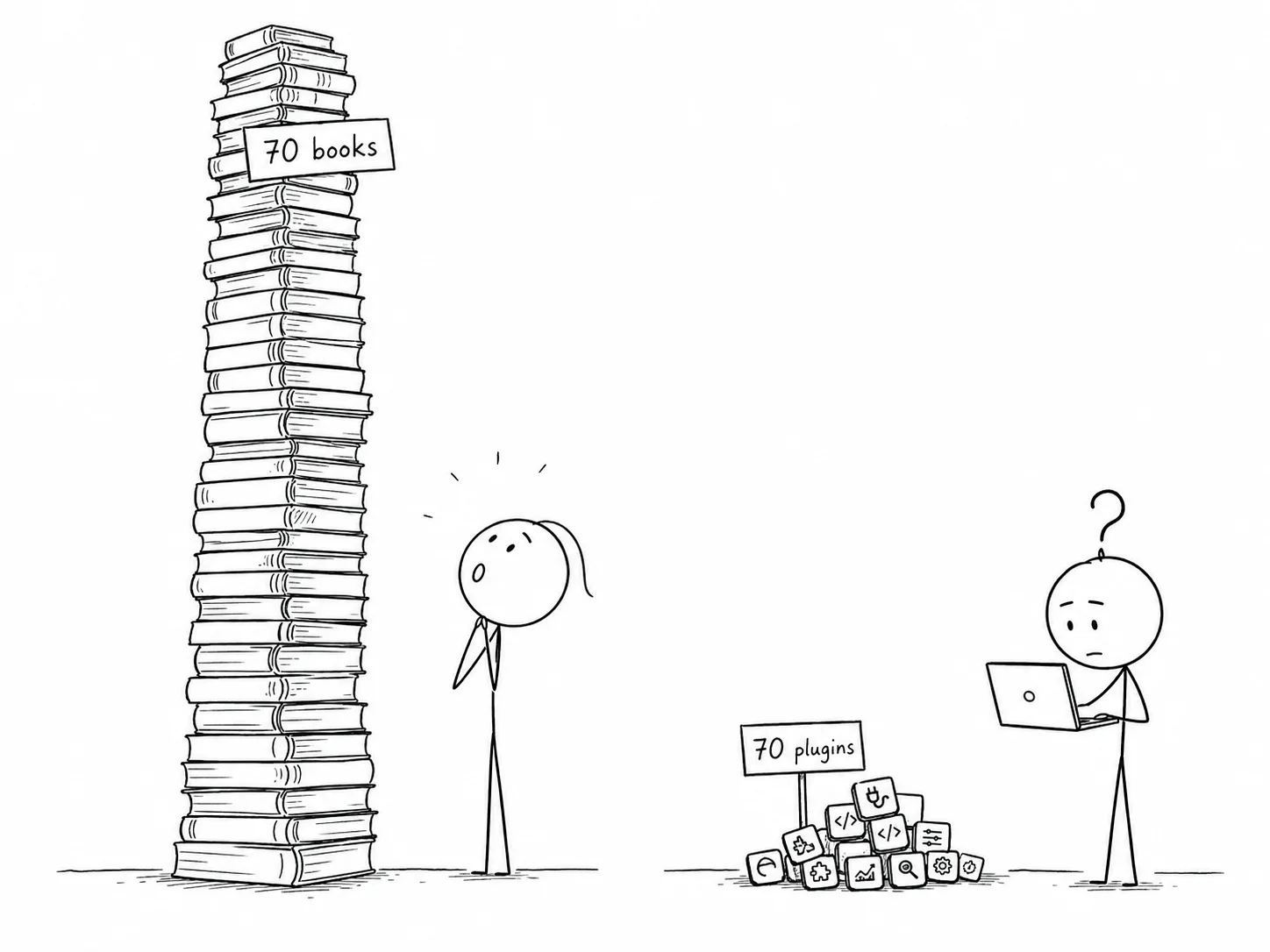
The patron saint of the second-brain cult is Niklas Luhmann, the German sociologist who kept around 90,000 paper notes in a wooden box and used them to write more than 70 books. Every PKM and zettelkasten guru on YouTube will eventually invoke Luhmann the way Catholics invoke Mary. The part they leave out is that Luhmann wrote 70 books and you have 70 plugins, claude code, codex, copilots, anki, graphify, karpathy’s and others.
It does not matter which app you use. Obsidian, Notion, Roam, Logseq, the next one, the one after that. The brand on the icon is a costume. Underneath every one of them is the same machine, doing the same job: activating the small tireless magpie-shaped part of your brain that loves shiny things and confuses arranging them with using them. It is the reason they make money. They have built, with real precision, a digital pet store for adults who want a hobby that looks like work, it’s an illusion and we can be taken over easily.
The curve nobody warns you about
Adding things is not free, and it does not stay flat. Economists figured this out two centuries ago in a simple form: add more of one input (fertilizer, hours, money) and at some point each new unit gives you less than the one before it. The curve flattens; we have called this diminishing returns for two hundred years, and that is where most people’s thinking stops.
In a complex system the curve does not just flatten; it bends down, and the bending happens in three distinct phases. In the first, you add input and the system gets better. In the second, you add input and the system gets a tiny bit better while breaking somewhere else, in a place you do not yet see. In the third, you add input and the system gets worse, because feedback loops amplify the noise, the bottleneck moves to a place that cannot take it, and you spend more energy keeping the system upright than getting anything out of it. Most things people are proud of in their PKM setup live deep in phase three. So does most of the second-brain industry’s pitch.
The cleanest signal that you are in phase three is this: the system has started asking for your time instead of returning it. If your “second brain” needs even a few minutes of grooming a day just to stay functional (tidy, synced, plugins happy, folders consistent), it is no longer serving you and you are serving it.
If you want to know which phase you are actually in before the curve has bent so far that you cannot tell, three heuristics carry most of the diagnostic weight:
- The last 20% of input gave you less than 5% of the output: you are nearing Phase 2, and the marginal hour has started to lie about itself.
- One metric improved while another quietly got worse: you are already in Phase 3, you just have not seen it yet, and the bill arrives on a Sunday.
- More now requires ever-larger control effort just to keep things from breaking: Phase 3, fully, and the only correct move is to stop adding.
None of this is about second brains specifically; it is how scaling actually works in your career, your relationships, your body, your codebase, and the dishwasher you keep cramming one more bowl into. The curve has the same shape every time, and the only honest move at the bottom of it is to stop adding and start cutting.
- Notes you actually use
- 14
- Notes piling up unread
- 0
- Plugins & platforms
- 8
- Grooming / day
- 7 min
Notes are a side effect of learning. You read what you save. One platform, almost no plugins, taxonomy you can hold in your head.
Saves outpace reads. A second plugin, a third tag layer, "let me try this other app". Notes pile up unprocessed. Maintenance starts asking for your time.
Syllogomania. Most notes are never reread. Most of your time goes to the system, not the learning. Reduce. Delete. Less is the path back.
I forgot what this note does
Phase three has exactly one way out: deletion.
I write code for a living so every codebase I have ever worked on gets simpler the moment somebody finally deletes the things nobody can explain. There is a rule, sometimes phrased as “if you cannot say in one sentence what this does, it probably does nothing”, and it is the closest thing the profession has to a religious commandment. Every line of code costs money to keep alive: somebody has to read it, test it, route around it, fear breaking it, and even AI hallucinates more the more packages get piled on top of each other. If a line cannot earn its rent, you can delete it, and the codebase exhales.
So tonight, before you close the laptop, open your “note taking app” and delete what you don’t need and had spent too much time. Pick the ones you secretly know are dead. The ones you keep scrolling past. The ones you “might use one day,” which is the lie you tell yourself when the truth is that you will not.
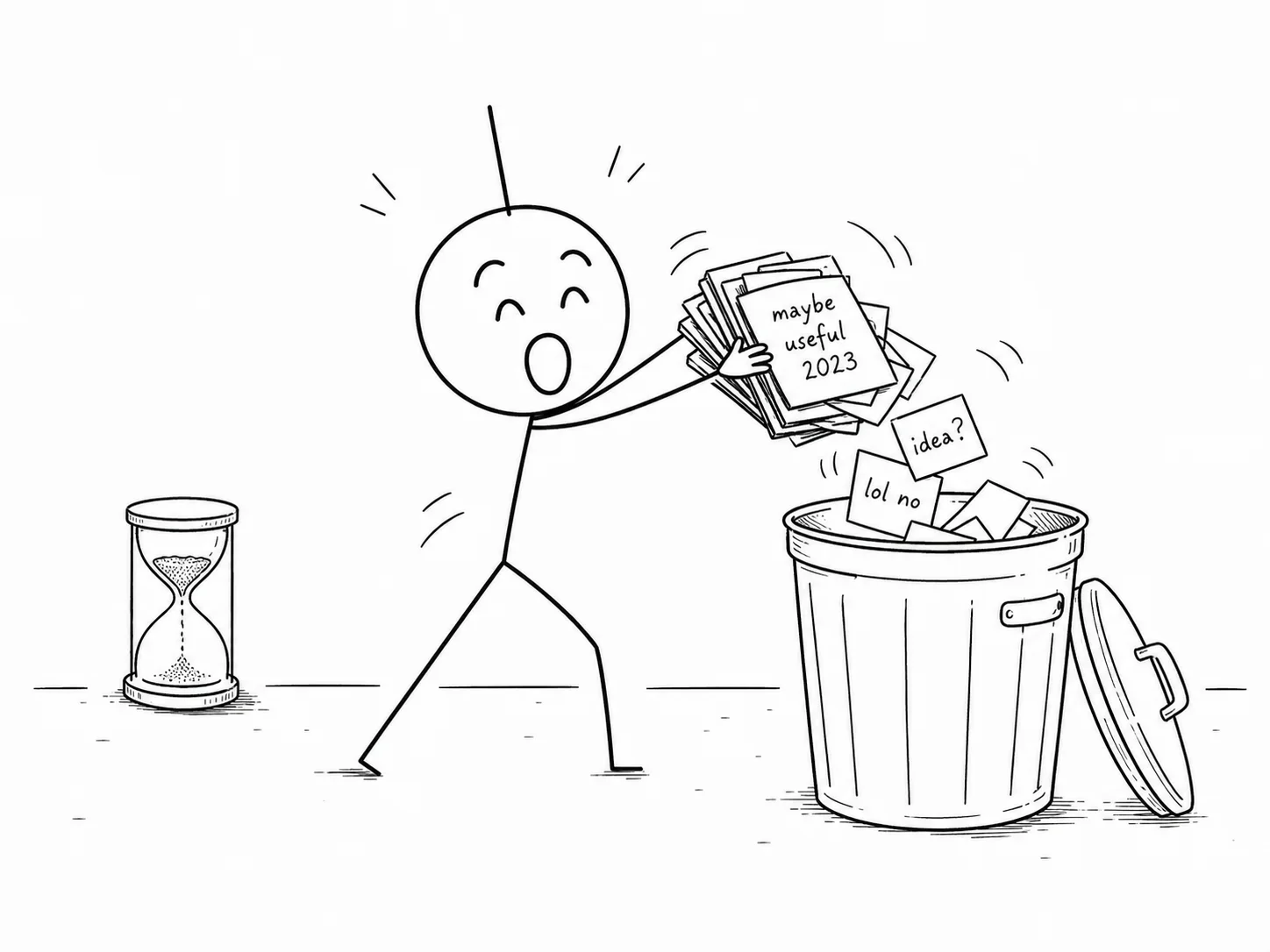
Then, if you want, send me a message and tell me how many notes/plugins you deleted, and which ones. I will be proud of you. I will not ask how many tags you renamed, or how many plugins you installed, or how many folders you rearranged. I will ask only about the notes that were actually doing something for you, and that you had the courage to let go of.
FAQ
Is building a second brain worth it?
For most people, no. Most of what gets called PKM is digital hoarding with a productivity flag stapled to it. You capture, you tag, you reorganize, you never recall the thing the notes were supposedly for, never use it, never let it touch a real decision. The system replaces the work it was supposed to support, and you mistake the system for the work.
What is wrong with the Zettelkasten method?
Of course there is something wrong with it. Zettelkasten, stripped of the romance, is just digital syllogomania given a German word and a tasteful interface, and what it actually produces is a shiny graph view, a pile of artificial connections you will never click again, and the warm illusion of having a system, while the only thing that ever made knowledge stick (your first brain arguing with an idea until it becomes part of you) never happens at all. Niklas Luhmann kept around 90,000 paper notes and wrote more than 70 books, but his box was downstream of a man who would not stop writing, and that is the part everyone invoking him on YouTube leaves out. Most of those people have 70 plugins instead of 70 books (Claude Code, Codex, Copilot, Anki, Graphify, Karpathy’s annotated transformer PDF they never read), a vault that is upstream of nothing, and a graph view they screenshot for X every other Sunday.
What about AI plugins, isn’t AI different?
No, the paint is newer but the machine is the same. AI plugins promise to outsource the processing, which is the part that actually makes knowledge stick: arguing with an idea, recalling it cold, applying it to a real choice. A model summarising your vault doesn’t do that for you. It just makes the pile of unread postcards bigger and faster, and gives you one more sidebar to groom at 9pm on a Tuesday.
Why does organizing notes feel so productive when it isn’t?
Because organizing pays out instantly: you move a note, the sidebar updates, you get a tiny dopamine hit and a tiny voice saying good, and the whole loop closes inside two seconds. Real learning, by comparison, pays out almost never, because you forget the answer you forgot last week, your Anki queue spits the same card back at you in the morning, and you fail it again before your coffee is finished. So you take the dopamine, restructure your daily-notes template at 9pm on a Tuesday, and call that work, because at least the sidebar updated, while the writing would have produced a sentence that did not yet sound right and a Sunday afternoon you are not getting back.
What is the only test that proves your second brain works?
The only honest test is that you stop changing it: if the system actually serves you, you are not chasing the next plugin, the next automation, the next tag scheme, but sitting down, opening the thing, doing the work, and closing it without thinking about the system at all. Cut everything to the minimum and keep it as simple as it goes, because the thing you are pretending to build does not actually exist: there is no second brain, only the one brain you were born with, sitting between your ears, doing the only kind of thinking that ever counted, and the question of why anyone would build a pixel copy of it instead of using the original is the question this whole article was about.
Should you delete old notes?
Yes, most of them. Most notes are Tuesday-evening enthusiasm: a thought you had once, captured because capturing was easier than asking whether the thought was any good. Reorganizing those instead of deleting them is the digital version of syllogomania. Throw the ham out. Give it to the dog. The notes you cannot bring yourself to delete are the only ones that were ever worth keeping.